
Sage Publishes Book by Research Fellow Angela Simms
“Fighting for a Foothold” examines how one D.C. suburb undermines the Black middle class

Russell Sage Foundation has published Angela Simms’s book, “Fighting for a Foothold: How Government and Markets Undermine Black Middle-Class Suburbia.”
Simms is an assistant professor of Sociology and Urban Studies at Barnard College as well as a research fellow with the Department of African American and African Diaspora Studies at Columbia University.
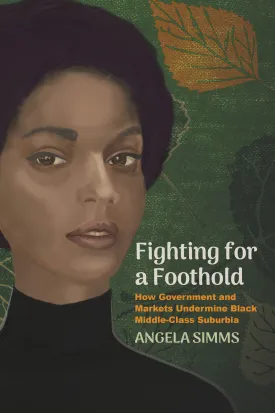
In “Fighting for a Foothold,” Simms examines the political economy of Prince George’s County, Maryland, through the lens of suburban Black middle-class jurisdictions’ capacity to garner sufficient tax revenue for maintaining high-quality public goods and services.
The publisher’s summary of the book notes that Simms drew on two years of observations of Prince George’s County’s budget and policy development processes and conducted interviews with nearly 60 Prince George’s leaders and residents, as well as budget and policy analysis for Prince George’s County and its two Whiter, wealthier neighbors, Montgomery County, Maryland, and Fairfax County, Virginia.
“‘Fighting for a Foothold’ is an in-depth analysis of the fiscal challenges experienced by Prince George’s County and by the suburban Black middle-class and majority-Black jurisdictions, more broadly,” according to the publisher. “The book reveals how race, class, and local jurisdiction boundaries in metropolitan areas interact to create different material living conditions for Americans.”
Published in February, the book has generated accolades from academics around the country.
Andre M. Perry is senior fellow and director of the Center for Community Uplift with the Brookings Institution and lives in Prince George’s County. He calls the suburb a “Wakanda of sorts,” as it is home to a strong majority Black middle class.
“Angela Simms’s rigorous work shows … that as remarkable as PG County is, it could be even better in a world without racism,” Perry wrote. “Fighting for a Foothold invites readers from all places to remove the drags of racism that throttle growth that would otherwise occur."
Perry’s observations are included in the publisher’s promotional materials for the book, as are those of Karen Lacy, associate professor of sociology at the University of Michigan.
Lacy wrote that Simms’s book “reveals the connection between a long legacy of racist policies in America and the struggle among local leadership in an iconic middle-class Black suburb to provide residents with the kinds of amenities that are taken for granted in neighboring middle-class White suburbs.”