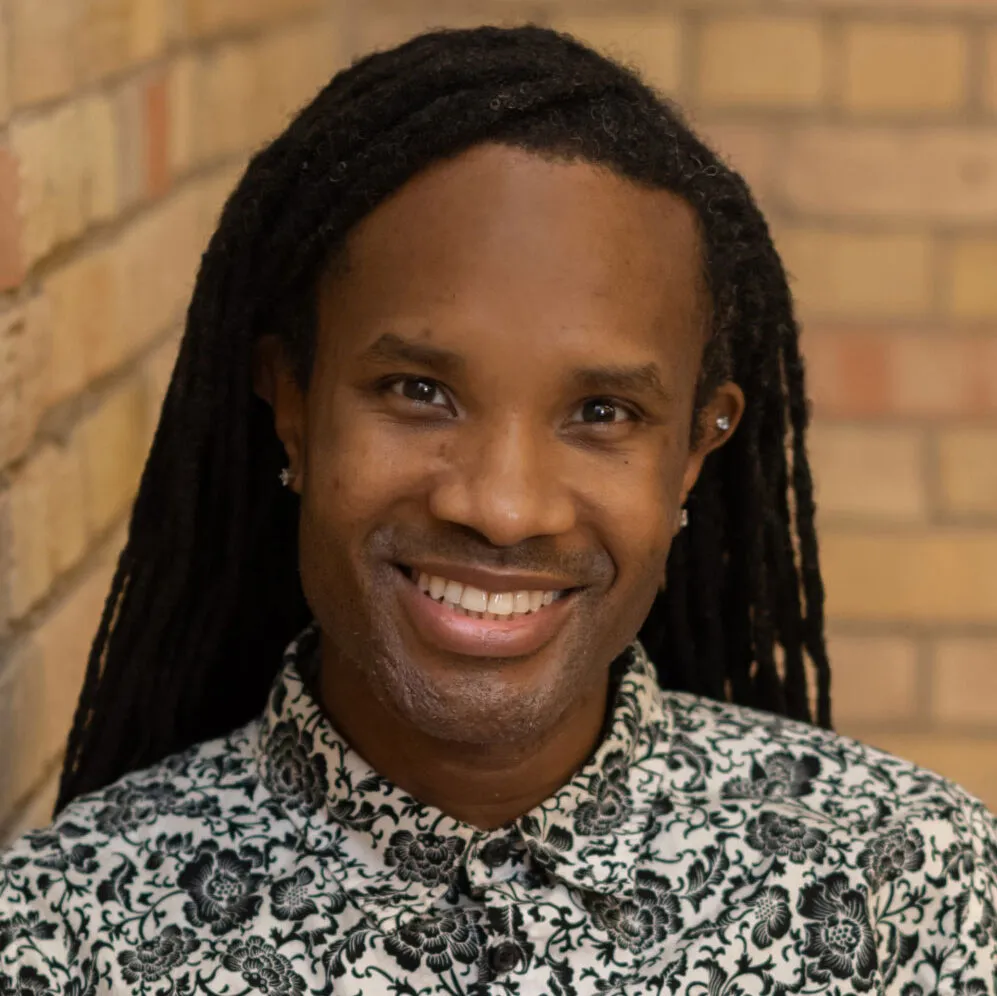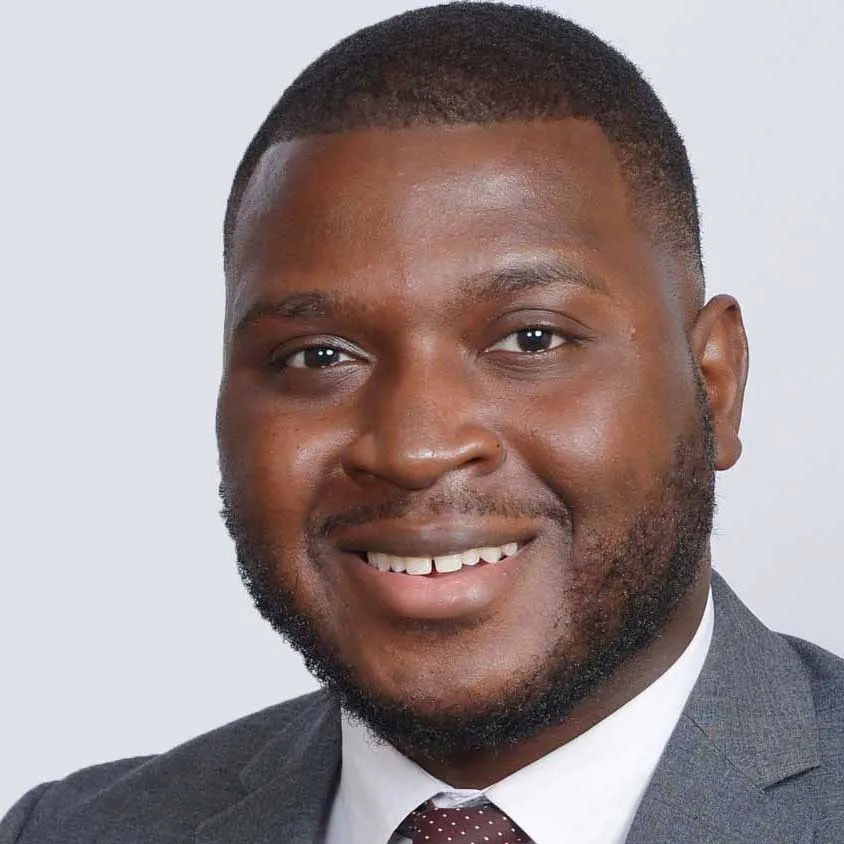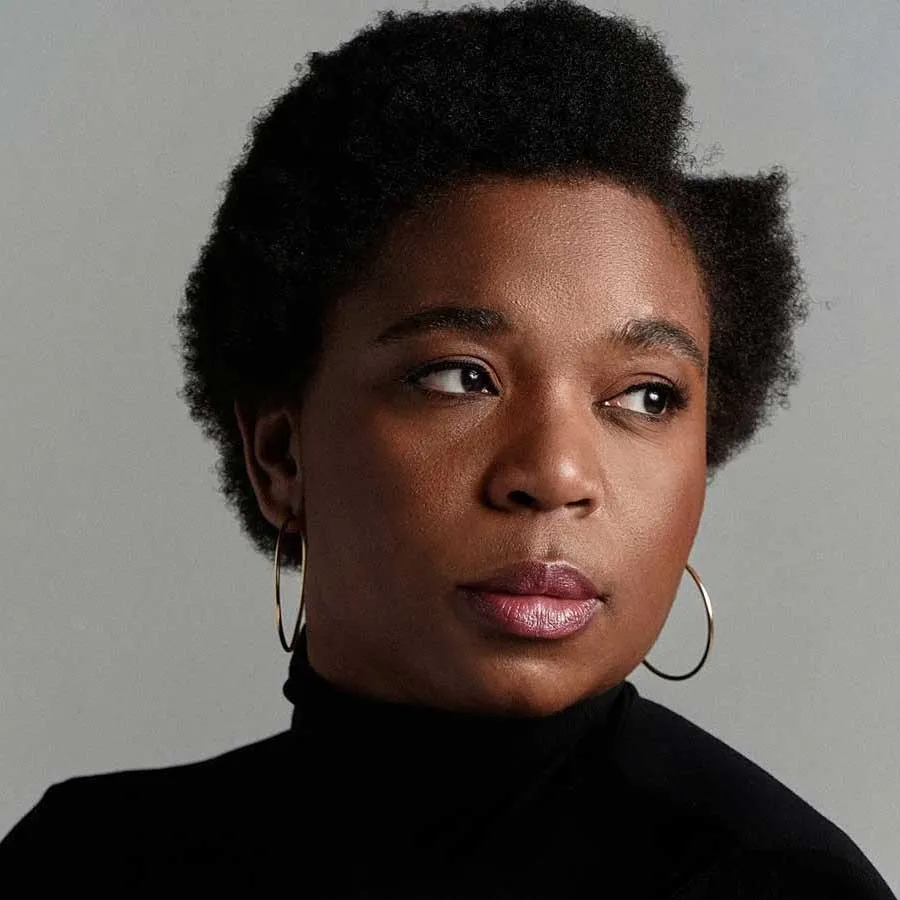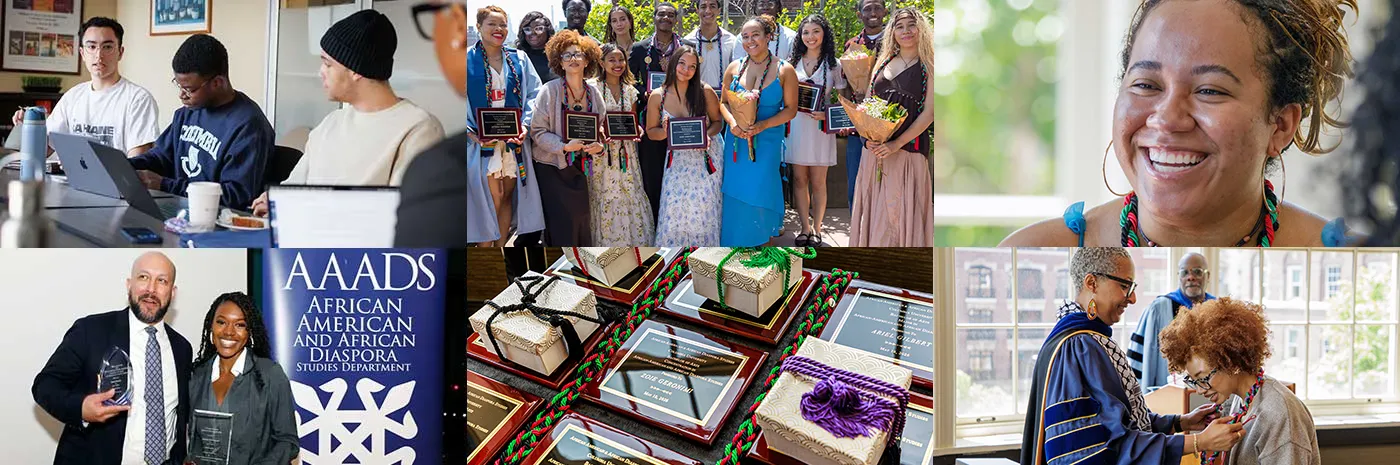
The academic program in African American and African Diaspora Studies for undergraduate students in Columbia College and the School of General Studies includes a major, concentration (for students graduating in 2026 and 2027), and minor. Our interdisciplinary curriculum examines the experiences of people of the African Diaspora — sub-Saharan Africa, Latin America and the Caribbean, the United States, Canada, and Europe. Course offerings span more than 60 courses in 10 academic departments and programs each year.
All undergraduate students are advised by a member of the Undergraduate Educational Committee, of which the director of Undergraduate Studies is a member. Students should schedule an appointment with a committee member to discuss their programs of study.
Programs of Study
A minimum of twenty-seven (27) points is required for the completion of the major. The major should be arranged in consultation with the director of Undergraduate Studies. Students interested in majoring should plan their course of study no later than the end of their sophomore year.
Core Requirements
All majors must complete to satisfaction the core required courses. The core requirements are:
Governed Electives
Majors must also complete "governed electives" from at least two departments, providing an interdisciplinary background in the field of African-American Studies.
Note that you cannot count one of your governed electives within your designated area of study.
Designated Area of Study
A Designated Area of Study, preferably within a distinct discipline (for example, history, politics, sociology, literature, anthropology, psychology, etc.) must also be completed. Students may also select courses within a particular geographical area or region or an interdisciplinary field of study.
- Any of the departmental disciplines (history, political science; sociology, anthropology, literature, art history; psychology, religion, music, etc.)
- Any of the pertinent area studies (African Studies; Caribbean/Latin American; Gender Studies; etc.)
Please note that the major/concentrator/minor is not allowed to “create” or “make up” a designated area of study without the direct approval of the director of undergraduate studies, and that such approval must be sought before the student has embarked on the course of designated area of study, and that such approval will be granted only in very rare and exceptional cases. For example, there conceivably could be a candidate for inclusion a Designated Area of Study that the student labels “Community Development and Empowerment in the African Diaspora,” which draws from courses in political science, sociology, history, etc., but only with permission from the director of undergraduate studies.
Under no circumstances should the major/concentrator hope to take a series of courses only later to “create” a Designated Area of Study around these courses.
A minimum of 19 points is required for the concentration. Minimum requirements are described below:
Core Requirements
Governed Electives
Majors must also complete "governed electives" from at least three departments, providing an interdisciplinary background in the field of African-American Studies.
Designated Area of Study
A Designated Area of Study, preferably within a distinct discipline (for example, history, politics, sociology, literature, anthropology, psychology, etc.) must also be completed. Students may also select courses within a particular geographical area or region or an interdisciplinary field of study.
- Any of the departmental disciplines (history, political science; sociology, anthropology, literature, art history; psychology, religion, music, etc.)
- Any of the pertinent area studies (African, Caribbean/Latin American, gender, etc.)
Please note that the major/concentrator is not allowed to “create” or “make up” a designated area of study without the direct approval of the director of Undergraduate Studies, and that such approval must be sought before the student has embarked on the course of designated area of study, and that such approval will be granted only in very rare and exceptional cases. For example, there conceivably could be a candidate for inclusion a Designated Area of Study that the student has labeled “Community Development and Empowerment in the African Diaspora,” which draws from courses in political science, sociology, history, etc., but only with permission from the director of Undergraduate Studies.
Under no circumstances should the major/concentrator hope to take a series of courses only later to “create” a Designated Area of Study around these courses.
The minor in African American and African Diaspora Studies requires five courses for 18 - 20 points.
- Introduction to African-American Studies – 4 Points
- Social Science Elective – 4 Points
- Humanities Elective – 4 Points
- Designated Area of Study Course (DAS) – 3 Points
- Designated Area of Study Course (DAS) – 3 Points
A minimum of 18 points is required for the minor. Minimum requirements are described below:
Students should consult with the director of Undergraduate Studies for assistance in designing their minor as soon as they declare. Introduction to African American Studies should be taken as early as possible since it provides the basic foundation for both the major and minor and introduces other areas of study; some students will have taken it prior to declaring the minor. The Social Science and Humanities electives are designed to give students a sense of interdisciplinary breadth. The designated area of study courses will give them the intellectual depth in a subfield, subject or geographic area and may be taken as they advance in the minor.
Governed Electives
Minors must also complete “governed electives’ from at least two departments that provide an interdisciplinary background in the field of African-American Studies.
Designated Area of Study
A Designated Area of Study, preferably within a distinct discipline (for example, history, political science, sociology, literature, anthropology, psychology, etc.) must also be completed. Students may also select courses within a particular geographical area or region or an interdisciplinary field of study.
- Any of the departmental disciplines (history, political science; sociology, anthropology, literature, art history; psychology, religion, music, etc.)
- Any of the pertinent area studies (African, Caribbean/Latin American, gender, etc.)
Please note that the major/concentrator/minor is not allowed to “create” or “make up” a designated area of study without the direct approval of the director of Undergraduate Studies, and that such approval must be sought before the student has embarked on the course of designated area of study, and that such approval will be granted only in very rare and exceptional cases. For example, there conceivably could be a candidate for inclusion a Designated Area of Study that the student has labeled “Community Development and Empowerment in the African Diaspora,” which draws from courses in political science, sociology, history, etc., but only with permission from the director of Undergraduate Studies.
Under no circumstances should the major/concentrator hope to take a series of courses only later to “create” a Designated Area of Study around these courses.
Course Lists
UNDERGRADUATE COURSES - FALL 2026
African American and Afrian Diaspora Studies | AFAS UN1001 - 001
Course Title: Introduction to African American Studies
Day/Time: Monday / Wednesday 2:40pm - 3:55pm
Instructor: Nyle Fort
Prerequisites: Students need to register for a section of AFAS UN1010, the required discussion section for this course.
From the arrival of enslaved Africans to the recent election of President Barack Obama, black people have been central to the story of the United States, and the Americas, more broadly. African Americans have been both contributors to, and victims of, this “New World” democratic experiment. To capture the complexities of this ongoing saga, this course offers an inter-disciplinary exploration of the development of African-American cultural and political life in the U.S. but also in relationship to the different African diasporic outposts of the Atlantic world.
The course will be organized both chronologically and thematically, moving from the “middle passage” to the present so-called “post-racial” moment—drawing on a range of classical texts, primary sources, and more recent secondary literature—to grapple with key questions, concerns, and problems (i.e. agency, resistance, culture, etc.) that have preoccupied scholars of African-American history, culture, and politics. Students will be introduced to a range of disciplinary methods and theoretical approaches (spanning the humanities and social sciences), while also attending to the critical tension between intellectual work and everyday life, which are central to the formation of African-American Studies as an academic field.
This course will engage specific social formations (i.e. migration, urbanization, globalization, etc.), significant cultural/political developments (i.e. uplift ideologies, nationalism, feminism, Pan-Africanism, religion/spirituality, etc.), and hallmark moments/movements (i.e. Harlem Renaissance, Civil Rights movement, etc.). By the end of the semester, students will be expected to possess a working knowledge of major themes/figures/traditions, alongside a range of cultural/political practices and institutional arrangements, in African-American Studies.
African American and African Diaspora Studies UN 3011 - 001
Course Title: Spirit of Justice
Day/Time: Monday 12:10pm - 2:00pm
Instructor: Nyle Fort
Progressive social movements are often read as critiques of systemic injustice and calls to transform social arrangements. In this framework, activism is largely - if not exclusively - a political project that addresses issues of housing, education, employment, healthcare, elections, labor, sexual violence, immigration, war, and climate, to name a few. Of course, these efforts are central to the long history of freedom struggles. Largely missing from such mainstream conceptions of activism, however, is serious attention to its spiritual work. That is, the ways social movements can transform hearts, minds, and spirits as much as material conditions, public policies, and political arrangements.
This course explores the intersection of social liberation and spiritual transformation, with particular focus on black and multi-racial freedom struggles in the Americas from the 19th century to today. Conceptually, it covers scholarship that speaks broadly to questions of love, spirituality, ethics, and religion in progressive political movements. Practically, it considers how this rich tradition of spiritual activism may help us confront legacies of injustice and struggle toward a liberated world.
African American and African Diaspora Studies UN3943 - 001
Course Title: Senior Pro Seminar
Day/Time: Tuesday 2:10pm - 4:00pm
Instructor: Farah J. Griffin
This course is a seminar for seniors to either write a formal proposal for a capstone project or to begin the research process for a Senior Thesis, which will be written in the Spring semester. This interdisciplinary course provides the necessary structure needed to complete either goal. This will be an interactive class in which students are required to participate and actively engage in each meeting.
AFRICAN AMERICAN AND AFRICAN DIASPORA STUDIES: UN 3943 - 001
Course Title: Senior Pro Seminar
Day/Time: Wednesday 12:10pm - 2:00pm
Instructor: Farah J. Griffin
AFAM Majors Only
This course is a seminar for seniors to either conduct a capstone project or to begin the research process for a Senior Thesis, which will be written in the Spring semester. This interdisciplinary course provides the necessary structure needed to complete either goal. This will be an interactive class in which students are required to participate and actively engage in each meeting. The classroom is designed to be a safe, respectful space in which the feedback given and received will be constructive and will assist students in working through the issues they may be experiencing with writing. Whether students will transition to academic or nonacademic spheres, this course is designed to help students cultivate effective writing and research skills and to develop oral presentation skills.
TOPICS IN THE BLACK EXPERIENCE - UN3930 - 002
Course Title: Freedom School
Day/Time: Monday 10:10pm - 12:00pm
Instructor: Nyle Fort
Course Title: Listening to Hip Hop UN3007 - 001
Day/Time: Monday 2:10pm - 4:00pm
Instructor: Ellie Hisama
UNDERGRADUATE COURSES - SPRING 2026
African American Studies UN3001 - Section 001
Blackness and Frenchness: A Radical Gene
Call Number: 10536 Points: 4
Day/Time: Monday, 12:10pm - 4:00pm
Instructor: Veronique Charles
How have Black radicals embraced the French language and, at times, Frenchness without espousing France’s dominance and its doctrines of assimilation? This course explores the watershed moments from the past three centuries that redefine the articulations of blackness in French, in France and beyond—from revolutionary or constitutional independence in the post-colony to recent social movements in continental Europe. In addition to the opening inquiry, guiding questions for this course include but are not limited to the following. What kinds of state-sanctioned backlash in France have ensued in the face of affirmative reclamations of blackness (e.g. Négritude and Afroféminisme)? And, what are the historical linkages between Black radicalism in France and the United States? Through an intra-imperial and inter-imperial lens, this course will center contributions from Black writers, artists, and intellectuals of divergent colonial histories with especial consideration to those for whom French and France is their native language and land.
African American Studies UN3001 - Section 001
Sing a Black Girl's Song: The Non Fiction Writing of Ntozake Shange
Call Number: 10540 Points: 4
Day/Time: Thursday, 2:10pm - 4:00pm
Instructor: Edwidge Danticat
This undergraduate seminar offers an in-depth exploration of the nonfiction work of the renowned African-American poet and playwright Ntozake Shange, whose archives are at Barnard College, her alma mater. Through readings, discussion, and visits to her archives, students will probe this lesser-examined aspect of Shange's oeuvre, including her essays on her life, the arts, food, and other artists and creators. This course invites participants to engage critically with Shange's essays and personal writings while delving into her archive.
Course Objectives:
Students will identify key themes and literary techniques in Shange's nonfiction and the historical and cultural context in which she wrote these works. We will examine how Shange's nonfiction contributes to her broader work and her perspectives on history, gender, feminism, and race as they intersect in her life as a Black woman artist. Students will develop critical thinking skills through close reading, analysis, and discussion of Shange's nonfiction and will improve their writing skills by composing reflections and essays on Shange's works. They will develop research skills and gain insights into Shange's creative process through firsthand engagement with Shange's archive at Barnard.
African American Studies UN3004 - Section 001
TOPICS IN THE BLACK EXPERIENCE: Introduction to Black Geographies
Call Number: 10540 Points: 4
Day/Time: Thursday, 2:10pm - 4:00pm
Instructor: Brandi T. Summers
This course will introduce students to Black geographies as a spatial expression of Black studies. Black scholars have long recognized the complex spatialities of Black life, developing theories of diaspora, racial capitalism, and anti-/post-colonialism that are inherently geographical. In this course, we will think about space, place, landscape, and ecology through a Black geographic framework, paying attention to how scholars, activists, and artists engage the poetics and materiality of Black life to explore ideas about repair, inequality, resistance, and liberation. The questions that animate this course are: what are Black geographies? What is the future of Black geographies outside of academia? How can centering a “Black sense of place” in turn transform the way we think about space, place, and power? How does Black Studies account for and understand Black spatial condition, experience, and imaginaries?
The course will begin with an engagement of key works on Black geographies. We will come to see institutional Black geographies as concerned with the Black spatial imaginaries formed in the aftermath of enslavement and colonialism in the Western hemisphere. As such, our readings will center experiences in the United States. We will cover such topics as Black method(s), racial capitalism, regional geographies, carceral geographies, and Black home and infrastructure.
Ultimately, students will be introduced to central themes, concepts and approaches that highlight the spatialization of race and the racialization of space through various technologies that signify places according to new rules of inclusion and exclusion. In this way, we will examine historical and contemporary macro-community and micro- sub-community (e.g., neighborhood) issues shaping the social, economic and political lives of Black people.
African American Studies UN3451 - Section 001
Latinx Artists Coast to Coast
Call Number: 15977 Points: 4
Day/Time: Wednesday, 4:10pm - 6:10pm
Instructor: Kellie Jones | Rachel Grace Newman
This course takes a close look at visual art and performative culture by artists of Latin American descent in the U.S. or Latinx, Latina/o art. The artists we will study trace their heritage to Mexico, Puerto Rico, the Dominican Republic, and Cuba, along with other countries in Latin America. We will consider how these wide-ranging and diverse creative expressions come to signify Latinidad while in the process transforming U.S. culture. This means examining colonial era histories that inform the work of contemporary Latinx artists including, but not limited to, histories of race and botanical illustration. We will also look at the histories and visual expressions of Afro-Caribbean and Taíno spiritual practices that have had a great influence on Latinx art production. Course themes include: physical and psychic borders, indigeneity, colonialism and racialization, gender and sexuality, and expanding notions of American art and identity. Class discussions will focus on close examination of theoretical approaches and individual works along with shifting ideas of representation.
African American Studies UN3011 - Section 001
Spirit of Justice
Call Number: 17123 Points: 4
Day/Time: Monday, 10:10am - 12:00pm
Instructor: Nyle Fort
Progressive social movements are often read as critiques of systemic injustice and calls to transform social arrangements. In this framework, activism is largely - if not exclusively - a political project that addresses issues of housing, education, employment, healthcare, elections, labor, sexual violence, immigration, war, and climate, to name a few. Of course, these efforts are central to the long history of freedom struggles. Largely missing from such mainstream conceptions of activism, however, is serious attention to its spiritual work. That is, the ways social movements can transform hearts, minds, and spirits as much as material conditions, public policies, and political arrangements.
This course explores the intersection of social liberation and spiritual transformation, with particular focus on black and multi-racial freedom struggles in the Americas from the 19th century to today. Conceptually, it covers scholarship that speaks broadly to questions of love, spirituality, ethics, and religion in progressive political movements. Practically, it considers how this rich tradition of spiritual activism may help us confront legacies of injustice and struggle toward a liberated world.
African American Studies UN3940 - Section 001
Senior Thesis Seminar
Call Number: 11372 Points: 4
Day/Time: Tuesday, 2:10pm - 4:00pm
Instructor: Kellie Jones
Note: AFAM majors and concentrators ONLY
The Senior Seminar will afford thesis writers the chance to workshop their idea, conduct research and/or interviews, work with the IRB protocols (if necessary), learn to work with archival materials, and perform other research activities prior to writing the thesis. Students who choose to write a capstone paper or conduct a capstone project can choose an elective course the following semester. The Thesis Seminar, conducted in the spring semester, is a workshop-oriented course for Senior Thesis writers organized around honing their writing skills while providing guidance to students in their field/disciplinary-specific projects. For example, a student may choose to write a historical biography of an artist while another may pursue a sociological study of the effects of mass incarceration on voting rights. The instructor of the Thesis Seminar, working with a faculty adviser (dependent on the specific field of inquiry in the thesis), will provide feedback and supervise the writing schedule of the students.
UNDERGRADUATE COURSES - FALL 2025
AFRICAN AMERICAN AND AFRICAN DIASPORA STUDIES: AFAS UN1001-001
Course Title: Introduction to African American Studies
Day/Time: Monday / Wednesday 2:40 pm. - 3:55 p.m.
Instructor: Nyle Fort
Prerequisites: Students need to register for a section of AFAS UN1010, the required discussion section for this course.
From the arrival of enslaved Africans to the recent election of President Barack Obama, black people have been central to the story of the United States, and the Americas, more broadly. African Americans have been both contributors to, and victims of, this “New World” democratic experiment. To capture the complexities of this ongoing saga, this course offers an inter-disciplinary exploration of the development of African-American cultural and political life in the U.S. but also in relationship to the different African diasporic outposts of the Atlantic world.
The course will be organized both chronologically and thematically, moving from the “middle passage” to the present so-called “post-racial” moment—drawing on a range of classical texts, primary sources, and more recent secondary literature—to grapple with key questions, concerns, and problems (i.e. agency, resistance, culture, etc.) that have preoccupied scholars of African-American history, culture, and politics. Students will be introduced to a range of disciplinary methods and theoretical approaches (spanning the humanities and social sciences), while also attending to the critical tension between intellectual work and everyday life, which are central to the formation of African-American Studies as an academic field.
This course will engage specific social formations (i.e. migration, urbanization, globalization, etc.), significant cultural/political developments (i.e. uplift ideologies, nationalism, feminism, Pan-Africanism, religion/spirituality, etc.), and hallmark moments/movements (i.e. Harlem Renaissance, Civil Rights movement, etc.). By the end of the semester, students will be expected to possess a working knowledge of major themes/figures/traditions, alongside a range of cultural/political practices and institutional arrangements, in African-American Studies.
AFRICAN AMERICAN AND AFRICAN DIASPORA STUDIES: UN 1002-001
Course Title: Major Debates - The Long Black 1980’s
Day/Time: Wednesday 12:10 p.m. - 2 p.m.
Instructor: Jafari Allen
This course will explore major debates in Black Studies from the vantage of 'the long 1980s'. While questions of Black ‘community’ inclusion and naming, representation, political strategy, and resistance, for example, have long historic genealogies; the long 1980s is distinguished by an explosion of discourses transmitted through popular and scholarly media. This course will survey a number of these— with specific attention to how a newly re-emergent ‘African American Studies’ contributed to public intellectual life, thus re-shaping itself as a feature of US Academe. Faithful to the themes of the debates of the era, we will pay particular attention to the significance of race, gender, sexuality, class, and nationality in Black politics, culture(s), and society— tracing how Black scholars’, critics’, and artists’ (re)conceptions of ‘articulation,’ ‘intersectionality,’ ‘Afrocentrism,’’ hegemony,’ and ‘white-supremacist capitalist patriarchy," e.g., sought to explain and contextualize contemporary popular culture, and political realities like the effects of deindustrialization and dawning of neo-liberalism, “police brutality,” AIDS, Apartheid, crack, Reagan/Thatcher, and public policies launched to address the so-called “crisis of the Black family,” for example. Beginning with a brief look at genealogies of African American and African Diaspora Studies, we will take up several of its most enduring major debates through a survey of popular and scholarly literature, social theory, film, music, ethnography, and historiography. The course will require primary independent and group research, listening, and screenings.
AFRICAN AMERICAN AND AFRICAN DIASPORA STUDIES: UN 3002-001
Course Title: Image Matters: Writing with photographs from the African Diaspora
Day/Time: Tuesday 2:10 p.m. - 4 p.m.
Instructor: Edwidge Danticat
"How should we understand the relationship between the family, the photograph, and the African diaspora?" asks the scholar Tina M. Campt in her 2012 book Image Matters. In this course, we will examine how some African American and African diaspora writers have used photographs or collaborated with photographers in writing poetry, fiction, essays, and criticism, expanding our understanding of their families, communities, and broader cultural and historical issues.
Students will "write with photographs" throughout the course and in midterm and final projects. They will develop skills in critically reading and interpreting written texts and visual imagery while exploring the intersection of literature and photography as a combined medium for storytelling and cultural expression. Students will enhance their writing skills by integrating photographs, their own and others', into their creative and analytical writing.
AFRICAN AMERICAN AND AFRICAN DIASPORA STUDIES: UN 3943-001
Course Title: Senior Pro Seminar
Day/Time: Wednesday 12:10 p.m. - 2 p.m.
Instructor: Farah J. Griffin
AFAM Majors Only
This course is a seminar for seniors to either conduct a capstone project or to begin the research process for a Senior Thesis, which will be written in the Spring semester. This interdisciplinary course provides the necessary structure needed to complete either goal. This will be an interactive class in which students are required to participate and actively engage in each meeting. The classroom is designed to be a safe, respectful space in which the feedback given and received will be constructive and will assist students in working through the issues they may be experiencing with writing. Whether students will transition to academic or nonacademic spheres, this course is designed to help students cultivate effective writing and research skills and to develop oral presentation skills.
GRADUATE COURSES - FALL 2025
AFRICAN AMERICAN AND AFRICAN DIASPORA STUDIES: GU4033-001
Course Title: Harlem and Haiti
Day/Time: Thursday 2:10 p.m. - 4 p.m.
Instructor: Edwidge Danticat
This graduate seminar explores the rich cultural and historical connections between the Harlem Renaissance in the United States and Haiti, the world's first independent Black Republic. Through an interdisciplinary approach, students will examine the linked literary, artistic, political, and social dimensions of the Harlem Renaissance and Haiti and how they have influenced and interacted with each other through their writers and artists. By analyzing key texts, novels, essays, travelogues, artworks, and historical documents, students will develop a comprehensive understanding of the connections between the Harlem Renaissance and Haiti and how they continue to resonate today. At the end of the course, students will have gained a deeper historical context, including the socio-political backgrounds and global influences that shaped and connected the Harlem Renaissance and Haiti, and will have honed the analytical and critical skills necessary to explore broader diasporic and transnational l connections.
AFRICAN AMERICAN AND AFRICAN DIASPORA STUDIES: GU4990-001
Course Title: African American Research Writing
Day/Time: Thursday 2:10 p.m. - 4 p.m.
Instructor: Rachel Grace Newman
The Black experience has been studied intensively by social scientists and humanists but also explored by writers and artists. This class examines in detail the concepts and categories that have been employed to document and analyze the lives of Black peoples across the diaspora. The course surveys different traditions of research, writing, and other forms of critical examination and creative exploration. Its objective is to prepare students for the interdisciplinary field of Black Studies. The class is discussion based with weekly readings and invited guests who will share work and offer insights on their disciplinary methods in Black Studies. The course is open only to graduate and undergraduate majors in African American and African Diaspora Studies. Students will be required to write short, weekly commentaries. Over the course of the seminar students will develop a thesis prospectus, including annotated bibliography, and present the final prospectus to the class. Exceptions may be made for other students at the instructor’s discretion.
TOPICS IN THE BLACK EXPERIENCE: AFASGU4080-001
Course Title: Colonial Visual Systems: Constructing a “New World”
Day/Time: Tuesday 12:10 p.m. - 2 p.m.
Instructor: Rachel Grace Newman
This course will examine the visual organizational systems used by Europeans during their colonization of the Americas, specifically the Caribbean. These systems were used in several ways: first, to classify what Europeans had never encountered through botanical and zoological illustration, then, as tools to assert control over groups of people and land through mapping practices and ethnographic illustrations. As such, the course will examine the broad history of colonialism, the transatlantic slave trade, and plantation visuality and surveillance beginning in the early fifteenth century and ending with contemporary questions around decolonization and methodology. The course will study how these visual systems were marshaled to create narratives that persist today, including the construction of racial hierarchies, the modern-day surveillance state, and land as kin to be protected or property to be exploited. The course emphasizes developing research skills using primary source materials to compose a convincing, inquisitive piece of writing. The main requirement will be a final 15–20-page paper and a student presentation so that each student can share their research with the class. Over the semester, we will work on developing this paper together; the goal is for students to have a paper they can use for conference presentations or even rework for publication. At the end of the course, the student will be versed in the colonial history of the Caribbean and Latin America and how visual systems developed there have functioned to construct systems of power and control.
TOPICS IN THE BLACK EXPERIENCE: AFASGU4080-002
Course Title: Writing and Editing the Black Studies Journal
Day/Time: Tuesday 12:10 p.m. - 2 p.m.
Instructor: Jafari Allen
Think of this as Black study research design studio in which the integrity of “an imagined moral-intellectual community” and the practicalities of journal writing and publication are held in balance.
“This is an introduction to the complex world of academic publishing and is designed to give writers in a variety of disciplines (including Black Studies) practical experience in getting their work published in peer-reviewed journals. …The goal of this course is to aid participants in taking their papers from classroom quality to journal quality and in overcoming anxiety about academic publishing in the process.
TOPICS IN THE BLACK EXPERIENCE: AFASGU4080-003
Course Title: "Authors of Black French Studies"
Day/Time: Monday 12:10 p.m. - 2 p.m.
Instructor: Veronique Charles
In this seminar, students will be introduced to as well as expand their knowledge of influential authors, including artists, who contributed to the field of Black French Studies, in its most capacious conception. These authors represent an assemblage of thought-leaders born in French-speaking Europe or its (former) empire in addition to those who sojourned in or expatriated to these regions. A sample of texts studied in this seminar include works by Anténor Firmin, Paulette Nardal, Awa Thiam, Maboula Soumahoro, Frantz Fanon, V.Y. Mudimbe, James Baldwin, Williams Wells Brown, Ousmane Sembene, and Alice Diop. Students will consider the gains of studying these works within their historical, geo-linguistic contexts as well as the complication and paucity of translation.
TOPICS IN THE BLACK EXPERIENCE: AFASGU4080-004
Course Title: That’s My Song!: Musical Genre as Social Contract
Day/Time: Wednesday 12:10 p.m. - 2 p.m.
Instructor: Guthrie Ramsey
Music in American history has been fundamental to identity formation because, as one scholar notes, it comprises “the deepest feelings and qualities that make a group unique. Through moving and sounding together in synchrony, people can experience feeling of oneness with others.” This course examines how various musical genres have served as “social contracts” among audiences throughout the process of this country’s nation-building process. Within America’s melting pot ideal, communities of listeners have asserted their powerful convictions about social identity through musical praxis and its “rules of engagement.” The discourse surrounding the notion of “genre” have often made these meanings legible, audible, and powerful for many. From Protestant church performance practices, to minstrelsy, to Tin Pan Alley to rock and hip-hop, the social agreements of musical genres help us understand the dynamism of American identities in formation.
AFRICAN AMERICAN AND AFRICAN DIASPORA STUDIES: GR6100-001
Course Title: African American Pro Seminar
Day/Time: Wednesday 2:10 p.m. - 4 p.m.
Instructor: Brandi Summers
AFAM MA Students ONLY
This course introduces students to central questions and debates in the fields of African American Studies, and it explores the various interdisciplinary efforts to address them. The seminar is designed to provide an interdisciplinary foundation and familiarize students with a number of methodological approaches. Toward this end we will have a number of class visitors/guest lecturers drawn from members of IRAAS's Core and Affiliated Faculty.
AFRICAN AMERICAN AND AFRICAN DIASPORA STUDIES: GR6999-001
Course Title: Thesis Research Graduate
Instructor: Brandi Summers
AFAM MA Students ONLY
UNDERGRADUATE COURSES - SPRING 2025
African American Studies UN3001 - Section 001
Sing a Black Girl's Song: The Non Fiction Writing of Ntozake Shange
Call Number: 10689 Points: 3
Day/Time: R 2:10 p.m. - 4 p.m.
Instructor: Edwidge Danticat
This undergraduate seminar offers an in-depth exploration of the nonfiction work of the renowned African-American poet and playwright Ntozake Shange, whose archives are at Barnard College, her alma mater. Through readings, discussion, and visits to her archives, students will probe this lesser-examined aspect of Shange's oeuvre, including her essays on her life, the arts, food, and other artists and creators. This course invites participants to engage critically with Shange's essays and personal writings while delving into her archive.
Course Objectives:
Students will identify key themes and literary techniques in Shange's nonfiction and the historical and cultural context in which she wrote these works. We will examine how Shange's nonfiction contributes to her broader work and her perspectives on history, gender, feminism, and race as they intersect in her life as a Black woman artist. Students will develop critical thinking skills through close reading, analysis, and discussion of Shange's nonfiction and will improve their writing skills by composing reflections and essays on Shange's works. They will develop research skills and gain insights into Shange's creative process through firsthand engagement with Shange's archive at Barnard.
African American Studies UN3004 - Section 001
TOPICS IN THE BLACK EXPERIENCE: Introduction to Black Geographies
Call Number: 17895 Points: 4
Day/Time: Tuesday, 12:10 p.m. - 2 p.m.
Instructor: Brandi T. Summers
This course will introduce students to Black geographies as a spatial expression of Black studies. Black scholars have long recognized the complex spatialities of Black life, developing theories of diaspora, racial capitalism, and anti-/post-colonialism that are inherently geographical. In this course, we will think about space, place, landscape, and ecology through a Black geographic framework, paying attention to how scholars, activists, and artists engage the poetics and materiality of Black life to explore ideas about repair, inequality, resistance, and liberation. The questions that animate this course are: what are Black geographies? What is the future of Black geographies outside of academia? How can centering a “Black sense of place” in turn transform the way we think about space, place, and power? How does Black Studies account for and understand Black spatial condition, experience, and imaginaries?
The course will begin with an engagement of key works on Black geographies. We will come to see institutional Black geographies as concerned with the Black spatial imaginaries formed in the aftermath of enslavement and colonialism in the Western hemisphere. As such, our readings will center experiences in the United States. We will cover such topics as Black method(s), racial capitalism, regional geographies, carceral geographies, and Black home and infrastructure.
Ultimately, students will be introduced to central themes, concepts and approaches that highlight the spatialization of race and the racialization of space through various technologies that signify places according to new rules of inclusion and exclusion. In this way, we will examine historical and contemporary macro-community and micro- sub-community (e.g., neighborhood) issues shaping the social, economic and political lives of Black people.
African American Studies UN3005 - Section 001
Introduction to Caribbean Art
Call Number: 17894 Points: 3
Day/Time: Tue/Thur: 2:40 p.m. - 3:55 p.m.
Instructor: Rachel Grace Newman
This course is a broad survey of art from the Caribbean region, spanning indigenous Taíno, Kalinago, and Garifuna art, contemporary art of the Caribbean and its diaspora, and art from the colonial era. The course will cover the history of the region including indigenous cultures from first Columbian contact to today, European exploration, arrivals, and conceptions of the “New World,” plantation economies, the transatlantic slave trade, the Haitian Revolution, art of maroon communities, and the syncretism of Afro-Caribbean spiritual practices like Vodou, Santería, Palo Monte, and the Abakuá. Throughout the semester, we will examine definitions of the term “Caribbean.” We ask if the term should be limited geographically to the Caribbean basin or take on a more cultural valence, expanding to places like Louisiana and Brazil, both of which share significant historical and cultural similarities with the countries from the Caribbean basin. Major themes of the class will include the impacts of colonialism, the transatlantic slave trade, the formation of the Afro-Atlantic diaspora, and legacies of the colonial era in contemporary art.
***note there will be a discussion section for this course***
African American Studies UN3006 - Section 001
Black Archival Theory and Praxis
Call Number: 18442 Points: 3
Day/Time: Wed: 12 p.m. - 2 p.m.
Instructor: Brandi T. Summers
Historically, archives have often served purposes of social control and territorial dominance through constructing normative accounts that assert authority about whose and which pasts are collectively significant. But Black people and Black communities have long documented their own histories , pointing to the possibility for archives to create “new histories of who we are (self-representation), who we were (identity construction), and who we want to be in this space (empowerment)” (Burgum, 2020, p. 9). Engaging historically displaced and disenfranchised communities as interpreters and investigators disrupts what counts as real knowledge and allows for a larger reading of archival data into alternative historical narratives – imagining not only what happened in the past, but also what could have been. What, then, are Black archives? What possibilities might they bring to assembling histories and experiences od Black life that are not reducible to presumed and documented experiences of racialized inequality and dispossession? How might we imagine, as Saidiya Hartman (2008) writes, “what cannot be verified…to reckon with the precarious lives which are visible only in the moment of their disappearance”?This course seeks to answer these and other questions as students navigate claims to authority inherent to archives, and the potential for archives to transcend their role in preserving a normative past and serve as a site of imaginative politics for those whose pasts are not always deemed collectively significant. Our readings and conversations will be organized around several themes, including care, home, refusal, fugitivity, and repair. Through our study of everyday individuals participating in archival acts of observing, recording, collecting, framing, we will build understanding of how social, political, and economic processes and practices of the past continue to shape our lives.
African American Studies UN3940 - Section 001
Senior Thesis Seminar
Call Number: 10703 Points: 4
Day/Time: Thursday: 4:10 p.m. - 6 p.m.
Instructor: Megan French-Marcellin
Note: AFAM majors and concentrators ONLY
The Senior Seminar will afford thesis writers the chance to workshop their idea, conduct research and/or interviews, work with the IRB protocols (if necessary), learn to work with archival materials, and perform other research activities prior to writing the thesis. Students who choose to write a capstone paper or conduct a capstone project can choose an elective course the following semester. The Thesis Seminar, conducted in the spring semester, is a workshop-oriented course for Senior Thesis writers organized around honing their writing skills while providing guidance to students in their field/disciplinary-specific projects. For example, a student may choose to write a historical biography of an artist while another may pursue a sociological study of the effects of mass incarceration on voting rights. The instructor of the Thesis Seminar, working with a faculty adviser (dependent on the specific field of inquiry in the thesis), will provide feedback and supervise the writing schedule of the students.
African American Studies UN3930 - Section 002
TOPICS IN THE BLACK EXPERIENCE: With New Eyes: Visual Culture and Critical Social Analysis
Call Number: 18240 Points: 4
Day/Time: Tues 4:10 p.m. - 6 p.m.
Instructor: J. Faith Almiron
How do we see each other as belonging to the same humanity? How do artists, curators and performers challenge and navigate visual representations of the social world? How does sub-culture create counter-narratives against stereotyping? What alternative imagery must we produce to transform our selves and the world? How does creative expression enable radical strategies to negotiate or to transgress the subjective binaries of sexuality, gender? How do queer and transgender frameworks reconcieve race, culture and society? With a focus on the cultural production of the 20th and 21st century, this inter-disciplinary course examines the social constructions of race, gender, sexuality and class within cultural and historical contexts. Applying a critical Ethnic studies framework, we study visual culture through the historical origins of world fair displays to museums (bodies and art objects as ethnographic study), fashion (dress, style, culturally-coded representation, photography), popular culture and mainstream entertainment (film, television) to policy, social protest and cultural movements.
As a seminar, students should be prepared to participate in depth discussion on a weekly basis by completing the reading and viewing assignments. Since the central subject matter is visual culture based in African-American studies, an inter-disciplinary field, there is a strong multi-media element in the course. Students will be expected to view films regularly both online and in-class. Students are also strongly encouraged to attend outside exhibitions and performances for extra credit. Syllabus is subject to change.