
A Conversation with Lee Bynum BA’02 MA’10
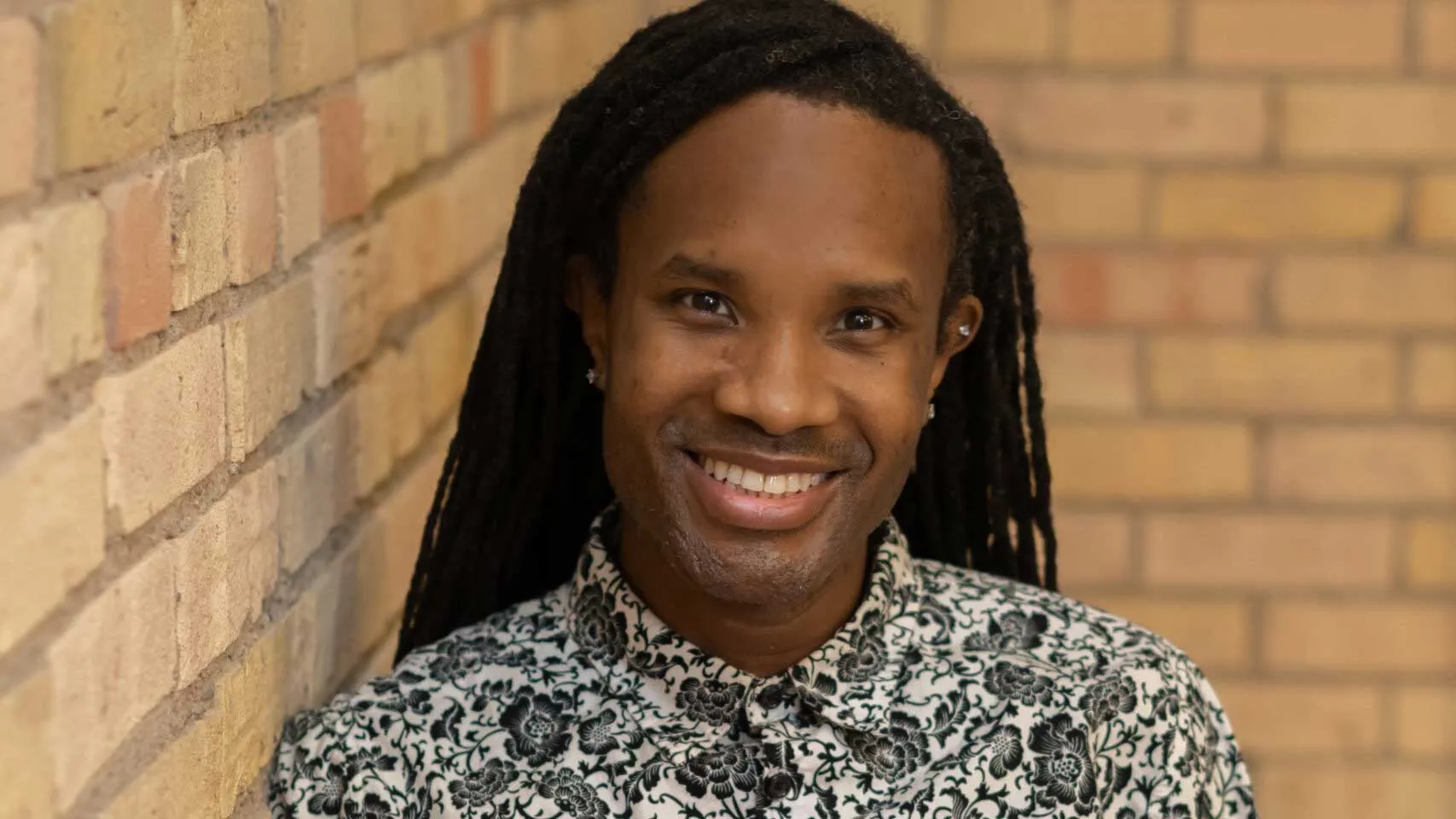
Lee Bynum BA’02 MA’10 is a composer and librettist of opera and serves as the executive director of Maestra Music, where they lead strategic, artistic, and operational initiatives that advance gender equity in musical theater.
After earning their BA and MA in what was then African American Studies at Columbia, Bynum continued at Columbia, earning an MPhil in in American History and Education and then a PhD in 2023 in the same field. While still a student, they founded The Harmony Theatre Company in 2001 and led it until the end of 2010, by which time it had become a successful non-profit theatre and dance company committed to developing new works by and about people of color.
Previously, Bynum was chief education officer at Lincoln Center and Vice President for Impact at Minnesota Opera. For nearly a decade Bynum was with the Andrew W. Mellon Foundation, eventually rising to the position of associate director of the Mellon Mays Undergraduate Fellowship. In addition to their role at Maestra, they are a consultant with both The Inclusion Firm and with the Aspen Leadership group, providing strategic thought partnership to the CEOs, artistic directors, and other leaders of arts organizations on inclusion, diversity, equity and accessibility matters.
In the fall, Bynum will assume the role of Distinguished Lecturer of Arts Administration at Baruch College, where they will be leading the graduate program and teaching courses in arts leadership.
What led you to Black Studies?
“As an undergraduate, I was learning a lot of interesting things vis-à-vis the Core, but I was really looking for some kind of intellectual counterweight that would be a little bit more reflective of my own experiences, my own heritage, and closer to my own interests.
“And Michael Eric Dyson, who was visiting at the Institute for Research in African American Studies (IRAAS preceded AAADS) at the time, was offering a course called Hip Hop America. This was before these kinds of courses had proliferated all over academe, and it was also before you had so many Black scholars as talking heads all over MSNBC and CNN, so I had never heard anyone who spoke about contemporary Black culture and politics quite like Professor Dyson. I was so interested in the course, and it sort of blew my mind. I had never expected, in a space like Columbia — where there was such a focus on masterpieces of Western art and culture — that there could be that kind of thoughtful, in-depth focus on contemporary Black subjects.
“This was the first course I'd ever received an A-plus in at Columbia, and it sort of got me thinking, ‘Maybe this is what I should be doing. This really could be the focus of my work.’ And from there, I took courses with Farah Griffin, Winston James, Mignon Moore, Monica Miller, and Amiri Baraka, and it was so exciting to have Black faculty in the classroom — and also to be in courses where there were other Black students, where Black students constituted the majority, and everyone was so focused on producing new knowledge on our own culture. I'd found a home.
What was the most transformative course you took at Columbia? Who taught it? Most impactful reading, discussion, performance, artwork, event, et. al.?
“I came to Columbia with a strong interest in studying music and theater, and I ultimately stayed for graduate school. I was getting my MA in African American Studies, and in my first semester, I took a pair of courses, and I'll talk about them together.”
“One was with Obery Hendricks on August Wilson, and the other was with Daphne Brooks on Black women in popular music. Given the courses in music and theater that I had taken all through undergrad, this was such a moment for me in terms of understanding the kind of research that I could do, the kind of intellectual community of which I could be a part, the kind of folks who could possibly be my colleagues. It really did shift how I worked, both as an artist producing works for theater and opera, and also as a person who studied them. And having the two courses at the same time accorded the opportunity to understand the depth of scholarship that existed in these fields. The experience let me know how much more was possible in the space.”
“In those two courses, I started to develop close friendships with people who now are also professors and constitute both my social circle and my academic community. Being able to see concerts or see theater with them in that context was brand new for me. I mean, I was well into my 20s, I had seen dozens of things on Broadway, I'd seen hundreds of concerts, but never as a part of an intellectual community. And that was profoundly motivating for my scholarship.”
What are you doing now and how did Black Studies at Columbia shape, perhaps even alter the trajectory of what you would do?
“I work as a composer and librettist of opera and occasionally musical theater, and I run a non-profit called Maestra Music, which does advocacy primarily for women and gender-expansive people who work in music on Broadway. In addition to that, I do a fair amount of consulting, with large arts organizations around the world.
“What brought me to this work was a profound understanding of social difference that came out of my time at IRAAS, where we were able to normalize and celebrate Blackness in a way that I had not experienced before academically, but also that was meant to unpack a lot of what makes America work in the strangely ahistorical and always complicated ways that it does. And that, as a foundation, has helped me to be able to understand the choices that people make as they relate to race and other forms of social difference. It has given me a skill set where I can communicate perspectives that are meant to improve how people are operating in the arts, including audience engagement, the development of new works, and philanthropic outreach with people of color.
“All of this comes from having the opportunity to sit for six years and think about race as the primary animating force in this country. And, you know, I… I don't think people would necessarily go to IRAAS because they're looking to be able to do that in the arts. Certainly, when I was an undergraduate, that wasn't what was being advertised on the seventh floor of Schermerhorn.
“I worked with Dr. Manning Marable as an undergraduate and as a graduate student and just really enjoyed him. He was such a great mentor, but one of the things that he asked me early on was, ‘What do you want to do?’ And I said, ‘I want to use my art to shift where Black people sit in a lot of these artistic conversations.’ He responded, ‘That's something you can do here.’ And I will never forget that, because no one before had made an effort to connect what I was doing academically with what I wanted to do artistically, to articulate that intersection as a valid form of activism.”
What advice would you have for students considering a degree in Black Studies?
“Black Studies is an incredibly capacious field where you can find a framework for understanding any number of things about contemporary or historical society. The kind of foundation that it offers is beneficial if you have an interest in going on to research America, whether it's in a humanistic or social scientific context. It's also practically beneficial in simply being able to read the society in which we all exist. As an historian, I see the cycles that America goes through — what feels often like a bit of a push and pull with Black people and Black culture. There's a way that Black Studies prepares you to read and navigate those cycles. Singularly. That's not something that I think every single academic field or discipline is designed to do.
“Black Studies prepares you, as a Black person, to be able to exist in that ebb and flow, and if you are not a Black person, it also can help you to understand why these things happen, and perhaps, how we can push back against them.”