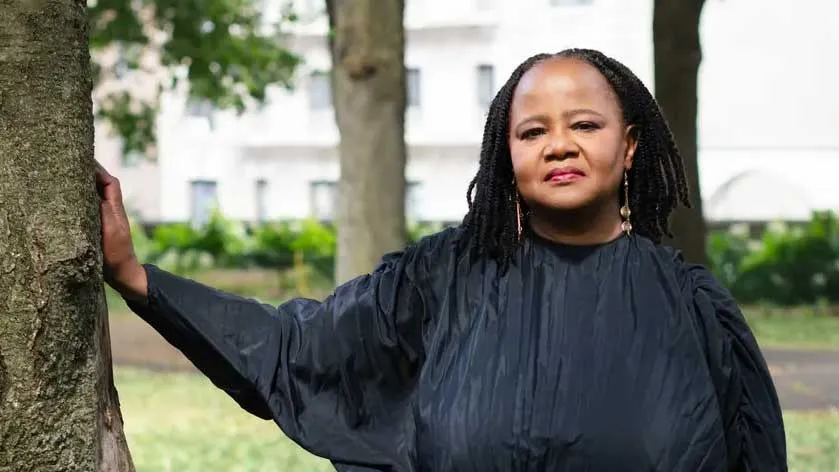
The New York Times published two stories last week on the new novel by Edwidge Danticat, the Wun Tsun Tam Mellon Professor of the Humanities and a professor of African American and African Diaspora Studies.
The first is a review of “Dèy,” Danticat’s latest novel: “She Survives a Mass Shooting, but Tells No One She Was There,” subtitled “In Edwidge Danticat’s new novel, “Dèy,” a Haitian American mother in Miami experiences the numbing aftershocks of a random act of violence.”
The Times also published a story that explores the story behind the novel: “‘Surviving Isn’t the End of the Story. It’s Where a Different One Begins.’” Subtitled “A terrifying personal experience inspired Edwidge Danticat’s fifth novel, which is set in Miami and Brooklyn, but with Haiti always in mind,” the story recounts her experience in a mall a decade ago: “when the sound of gunfire erupted, causing widespread panic. She hit the floor, a rush of thoughts running through her head — about her own mortality, her responsibilities to her two young daughters.”
The gunshots turned out to be a hoax, a recording amplified by a boom box, but the experience continued to haunt her. Danticat wrote about the experience in “We’re Alone,” her 2024 collection of essays, before returning to the incident in fiction.
A contributor to The New Yorker since 1999, Danticat is the author of 19 books, including "Breath, Eyes, Memory," an Oprah Book Club selection, "Krik? Krak!," a National Book Award finalist, "The Farming of Bones," an American Book Award winner; the novels-in-stories, "The Dew Breaker," "Claire of the Sea Light," and "The Art of Death," a National Book Critics Circle finalist for Criticism. She has written seven books for children and young adults, a travel narrative, "After the Dance," and two essay collections, "Create Dangerously" and "We're Alone.”
In March she received the PEN/Nabokov Award for Achievement in International Literature. In April the Schomburg Center for Research in Black Culture honored her with five others for outstanding achievements in their respective fields of arts, culture, literature, and scholarship.