
Souls’ 25th Anniversary Volume Marks First Edition Free and Open to the Public
After a decade away, the academic journal about Black study(ies) comes home to Harlem where it was founded
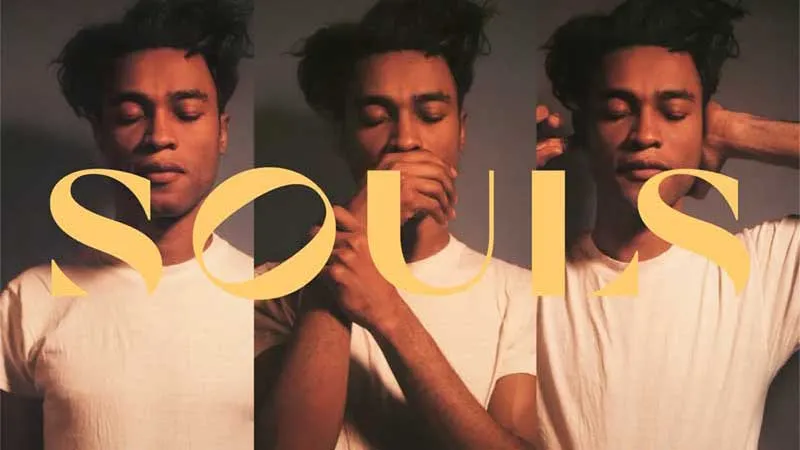
The cover of Volume 25 of Souls Journal features a Polaroid triptych of a young man in a reinterpretation of the classic three wise monkeys’ proverb, see no evil, hear no evil, speak no evil. Created in 1995 by American artist Carrie Mae Weems, the images are an examination of cultural complicity, willful ignorance and systemic silence regarding race and identity in America.
They are also a call to action, reinforced by the volume’s title – “Divest/Invest” – according to the introduction by Jafari S. Allen, Souls editor-in-chief and director of IRAAS, the Institute for Research in African American Studies. More than 30 years after the photos were created, Allen envisions the subject of the images about to open his eyes and ears and to open his mouth to speak.
“Against the monkeys' putative wisdom, this volume chats back: See. Say. Insist. We imagine the frame expanded in every direction beyond the beautiful portrait, revealing an entire collective arrayed to do the same. No longer crucially alone, it matters less that they—we—are afraid. That is the argument of this volume, celebrating more than twenty-five years of uninterrupted publication of Souls, compressed into three Polaroids.”
The moment demands it, Allen wrote.
“In the time it has taken to make this volume, the University of Texas at Austin folded its Department of African and African Diaspora Studies into a generic administrative unit; Florida stripped Black-studies courses of their standing and cut the research money faculty depend on; Kentucky suspended a Pan-African studies doctoral program outright. The federal government has opened civil-rights investigations into dozens of universities at once; the language of civil rights is being turned against the people it was written to protect. Student hearings were transformed into kangaroo courts, campuses were seized and occupied. Civil rights have been rolled back and rolled over.”
The volume includes a special section on Katrina’s aftermath in New Orleans.
“Marking twenty years after breached levees illustrated, in Katrina’s aftermath, the results of the long-ago breached promise of true Black citizenship: the first issue of our 25th anniversary volume closes on New Orleans,” Allen wrote. “The special section “After the Storm” was guest-edited, alongside our staff, by Shreya Subramani, Christien Philmarc Tompkins, and Kaya Williams.”
Allen acknowledged that the theme of the edition’s title may be scary for some people, as Divest/Invest, borrowed from environmental, anti-apartheid, abolition, Gaza-solidarity, and M4BL activist movements.
“The call was occasioned by a divestment we all watched and in which many actively participated,” Allen wrote. “A multiracial coalition of students—at Columbia, and on campuses around the world—forced the word divest back into the center of public life, revived the old anti-apartheid demand, and paid for it at high costs. We wrote the call in that weather: this volume is a child of that moment.”
Founded by Manning Marable, Souls had been behind a pay wall and challenging for the public to access – like many academic journals – for the bulk of its existence. Following Marable’s death, the Department of African American Studies at the University of Illinois at Chicago stewarded the publication from 2012 to 2022.
“And now the journal has come home to Harlem,” Allen wrote. “Volume 24’s last issue was our first featuring work on a platform of our own. Volume 25—this twenty-fifth anniversary volume—is the first that is open, free, and on a purpose-built platform, with no one standing between the editorial collective and you.
“Which is to say: Souls has always been a journal of Black study(ies) as intimacy and diasporic imagination—named in mourning, carried by women, gesturing past its own founding grammar toward full intramural Blackfullness, inside the veil.”