
Steven Gregory’s book on Harlem published posthumously by NYU Press
His book charts racialized and class-based exclusion in Morningside Heights and its surrounding area by elite institutions.

Steven Gregory, the inaugural Dr. Kenneth and Kareitha Forde Professor of African American and African Diaspora Studies at Columbia University, finished his final book shortly before his passing in 2021. “Towering Above Harlem: Geographies of Race and the Power of Elite Institutions” was published in September by NYU Press, which describes the book as charting “the coordinated effort among elites to use space to naturalize relations of power and prestige, illuminating the past, present, and uncertain future of racial discrimination and exclusivity in Morningside Heights and in New York City at large.”
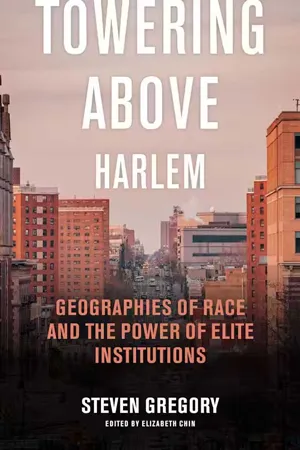
Gregory’s book includes a foreword by Arlene Dávila and was edited by Elizabeth Chin.
According to the publisher’s description, “‘Towering Above Harlem’ focuses on understudied players in this process: the elite institutions of Morningside Heights — Columbia University, Teachers College and the Riverside Church — to reveal the troubling ways in which they exploited existing geographic features to build a racially and economically exclusive “‘city on a hill.’”
The book has already garnered much praise from his peers.
|Steven Gregory has gifted us a third, tremendous contribution to a field he unknowingly pioneered: Black Geographies,” said Jacqueline Nassy Brown, author of “Dropping Anchor, Setting Sail: Geographies of Race in Black Liverpool.” “Towering Above Harlem” will tower over that field in perpetuity. It will also provide a forever manual on how—and why--to read the racialized and spatialized cultures of our most powerful institutions. What a legacy!"
Gregory came to Columbia in 2000 and held a joint appointment as a professor in the Department of Anthropology. His extraordinary work in Anthropology on the intersection of race, class, gender and urban-based social movements unfolded in numerous books and articles, notably the volumes “Black Corona: Race and the Politics of Place in an Urban Community” (1998), “Santería in New York City: A Study in Cultural Resistance” (2000), and “The Devil Behind the Mirror: Globalization and Politics in the Dominican Republic” (2007), which received the Society for Urban Anthropology’s Anthony Leeds Prize, and the Gordon K. Lewis Book Prize, from the Caribbean Studies Association.